

 Polski
 Deutsch
 Türkçe
 Français
 Español
 Suomi
Suomi
 Bokmål

KYC and KYB – Key Verification Procedures in Business
Introduction
The modern world of finance and business requires effective tools for verifying customers and partners. Two key procedures used in this regard are KYC (Know Your Customer) and KYB (Know Your Business). Both procedures play a crucial role in preventing money laundering (AML – Anti-Money Laundering) and countering the financing of terrorism (CFT – Countering the Financing of Terrorism), ensuring transaction security and compliance with legal regulations.
What is KYC?
KYC is the process of identifying and verifying the identity of individual customers before establishing a business relationship. Its purpose is to eliminate risks associated with criminal activities and financial fraud.
Key elements of KYC:
-
Identity verification – required documents, such as an ID card or passport.
-
Proof of life – facial verification ensuring the presence of a live person.
-
Address verification – e.g., utility bills, bank statements.
-
Customer profile analysis – source of income, transaction history.
-
PEP screening (Politically Exposed Person) – identification of individuals holding high-profile political positions.
-
AML risk analysis – transaction monitoring and compliance with regulations.
What is KYB?
KYB focuses on the identification of companies and businesses that establish business relationships. Its main objective is to ensure that the organization operates legally and is not being used for money laundering or fraud.
Key elements of KYB:
-
Company registration verification – e.g., KRS, NIP, REGON.
-
Identification of Ultimate Beneficial Owners (UBO) – individuals controlling the company.
-
Verification of ownership structure and management.
-
PEP screening (Politically Exposed Person) – identification of politically exposed persons and individuals financially associated with them.
-
AML risk analysis – monitoring transactions, business, and financial connections.
Differences between KYC and KYB
-
KYC applies to individual customers, while KYB applies to companies and businesses.
-
KYC focuses on verifying the identity of a natural person, while KYB focuses on the structure and legality of the business entity.
-
KYB includes a more comprehensive analysis, such as identifying beneficial owners and assessing AML risks at an organizational level.
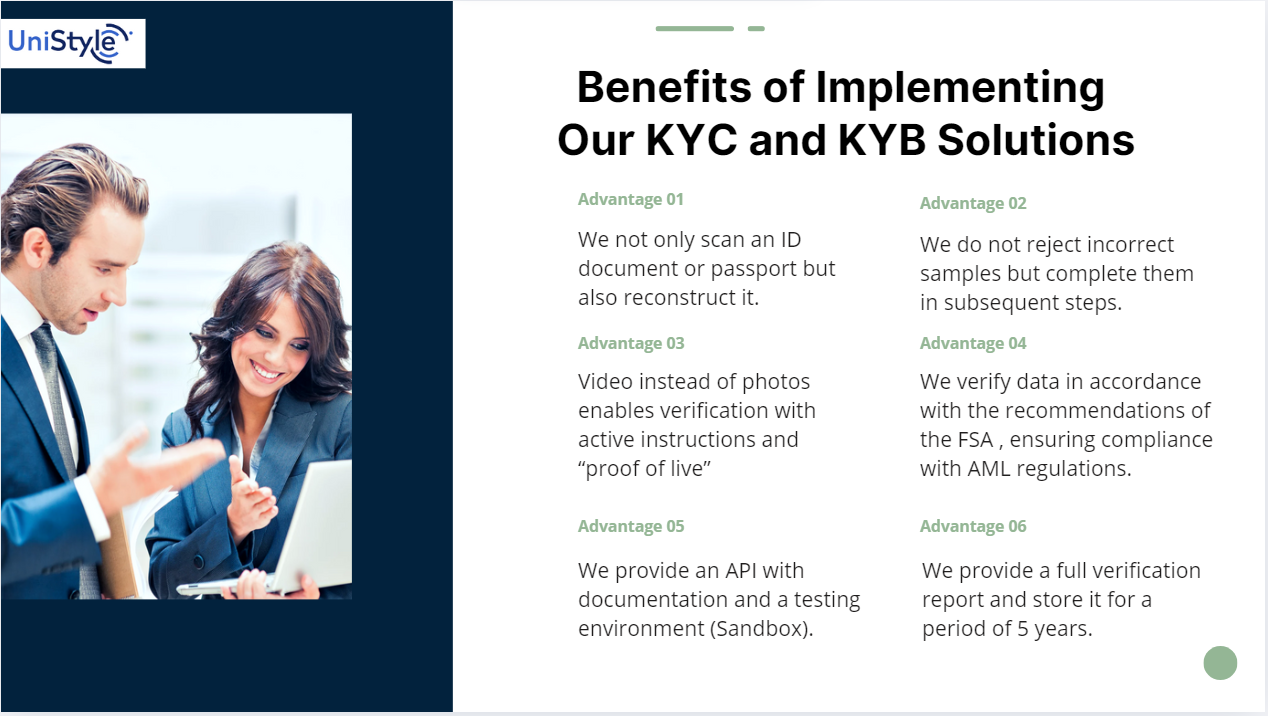
Benefits of Implementing KYC and KYB
-
Minimization of financial fraud and money laundering risks.
-
Compliance with legal regulations (AML, CFT).
-
Increased trust in business relationships.
-
Enhanced company reputation and compliance with global standards.
Benefits of Implementing Our KYC and KYB Solutions
-
We not only scan an ID/passport but also reconstruct documents.
-
We do not reject incorrect samples but complete them in subsequent steps.
-
Video instead of photos enables verification with active instructions.
-
We verify data in accordance with KNF recommendations, ensuring AML compliance.
-
We provide an API with documentation and a testing environment (Sandbox).
-
We deliver a full verification report and store it for a period of 5 years.
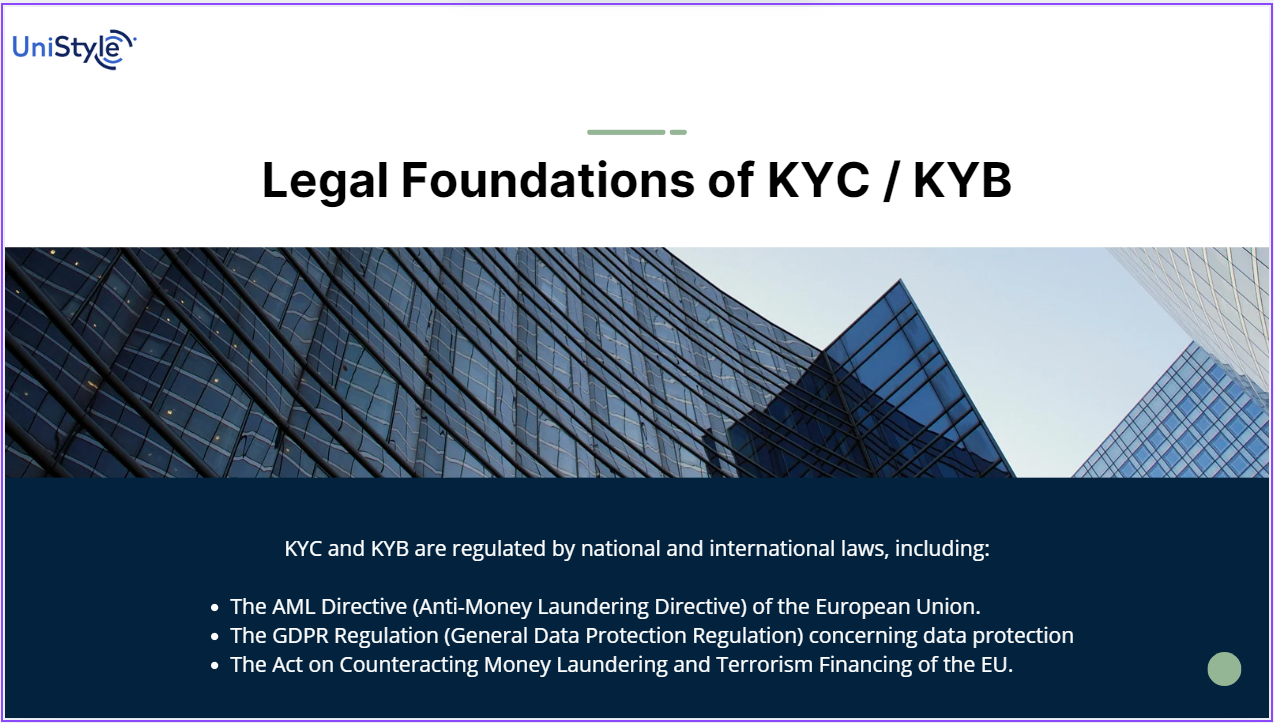
Legal Foundations
KYC and KYB are regulated by national and international laws, including:
-
The AML Directive (Anti-Money Laundering Directive) of the European Union.
-
The GDPR Regulation (General Data Protection Regulation) concerning data protection.
-
The Act on Counteracting Money Laundering and Terrorism Financing.
Conclusion
KYC and KYB are key verification procedures that help financial institutions and businesses avoid legal and financial risks. Implementing effective customer and business identification processes is not only a legal obligation but also an essential element of building trust and security in business.

Order a free KYC/KYB consultation for your company: roman.zurowski@contric.com
or
