
 Polski
 Deutsch
 Türkçe
 Français
 Español
 Suomi
Suomi
 Bokmål

Why and for Whom a Qualified Electronic Signature Is Needed
Why and for Whom a Qualified Electronic Signature Is Needed
What Is a Qualified Electronic Signature?
A Qualified Electronic Signature (QES) is the highest level of electronic signature, legally equivalent to a handwritten signature under the EU eIDAS Regulation.
It is created using a qualified certificate issued by a trusted provider and a secure signing solution – today very often in the form of a cloud-based signature.
A document signed with a qualified electronic signature:
-
has full legal validity,
-
does not require a paper version,
-
is recognized across all European Union countries.
Why Is a Qualified Electronic Signature Important?
1. Full Legal Effect
A qualified electronic signature:
-
is legally equivalent to a handwritten signature,
-
can be used for contracts, official documents, corporate and legal paperwork,
-
is accepted by courts, public authorities, and financial institutions.
This makes it suitable for even the most formal and legally sensitive documents.
2. Remote Signing – Anytime, Anywhere
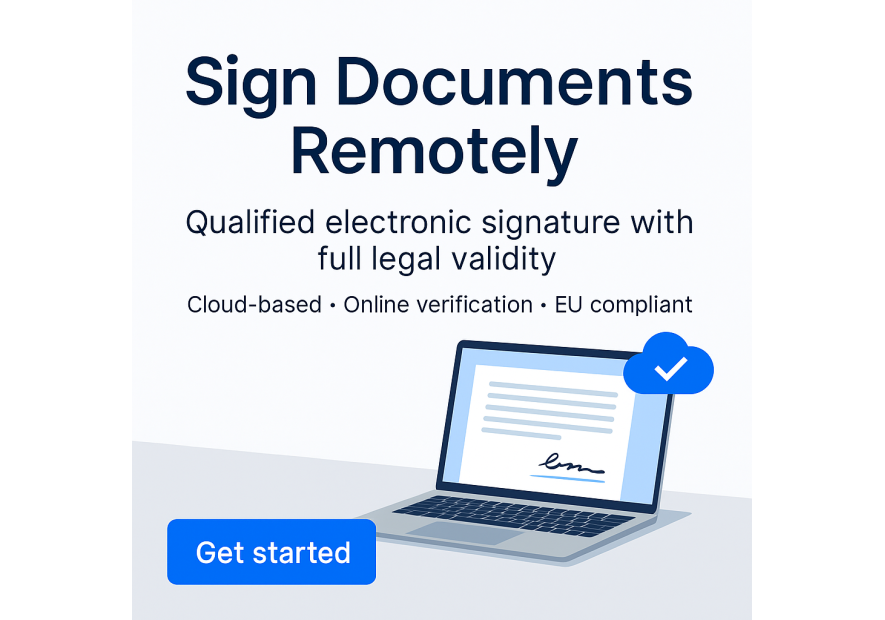
One of the key advantages of a qualified electronic signature is the ability to sign documents remotely.
In practice, this means:
-
documents can be signed from anywhere in the world,
-
no physical meetings are required,
-
no printing, scanning, or mailing of documents,
-
contracts can be finalized within minutes, even between parties in different countries.
With a cloud-based qualified signature and online identity verification, the entire process – from obtaining the signature to using it – can be completed fully online.
3. Efficient Online Communication with Authorities
A qualified electronic signature allows users to:
-
submit documents to public authorities electronically,
-
sign financial statements and official filings,
-
handle tax and regulatory documents remotely,
-
represent companies without physical presence.
This is especially valuable for international businesses and remote teams.
4. Time and Cost Savings
Using a qualified electronic signature:
-
reduces operational costs,
-
speeds up document workflows,
-
eliminates delays caused by traditional paper processes,
-
enables faster decision-making and deal closing.
5. High Level of Security
A qualified electronic signature:
-
uniquely identifies the signer,
-
guarantees document integrity after signing,
-
complies with strict EU security standards,
-
uses advanced cryptographic protection.
Who Needs a Qualified Electronic Signature?
Business Owners and Companies
-
signing commercial contracts,
-
corporate filings and registry documents,
-
remote management and board decisions.
Accountants and Financial Professionals
-
signing financial statements,
-
submitting tax documents,
-
representing clients before authorities.
HR Departments
-
employment contracts and annexes,
-
digital employee documentation,
-
remote hiring processes.
Lawyers, Advisors, Consultants
-
legally binding client documents,
-
secure and compliant remote workflows,
-
fast document turnaround.
Private Individuals
-
civil law contracts,
-
official correspondence,
-
handling formal matters without visiting offices.
Summary
A qualified electronic signature is a modern and legally robust solution that:
-
has full legal force,
-
enables secure remote document signing,
-
simplifies administrative and business processes,
-
saves time and costs,
-
is valid throughout the European Union.
It is an essential tool for anyone who values efficiency, flexibility, and legal certainty in a digital environment.
✨ Ready to Sign Documents Remotely with Full Legal Validity?
Buy a qualified electronic signature with online identity verification and sign documents securely in the cloud – anytime, anywhere.
